Families caught in the earthquake are facing life-threatening shortages of shelter, food, and medical care. With homes destroyed and villages cut off, survivors are depending on urgent assistance to stay safe and begin rebuilding their lives.
Right now, our team is:
Your urgent support today will enable Hagar to act quickly in this emergency, while also standing ready for the long road of recovery.
A destructive 6.0-magnitude earthquake has ripped through eastern Afghanistan, leaving entire communities in ruins. Whole neighbourhoods have collapsed, health posts are out of service, and thousands of people are now in urgent need of help.
The quake struck after weeks of relentless rain and flooding, which had already destabilised fragile mountain terrain. Many villages are now unreachable, with landslides and damaged roads preventing relief teams from getting through.
Survivors who managed to escape are camped outside with no protection from the elements. They are without food, safe water, or medicine, and local health services have been overwhelmed by the number of injured.
In districts like Mazar Dara in Nurgal, the devastation is almost complete. Residents say nearly every home has collapsed, with multiple injuries in each household. One local described the atmosphere as one of terror and despair, as families search for loved ones among the rubble.
As the UN has described, this disaster adds to a “perfect storm” of crises in Afghanistan, including the recent forced return of nearly two million people from Iran.
Hagar has a long-standing office in Kabul. Our team is safe but deeply shaken. They are already working with local networks, community leaders, and the national emergency coordination effort to understand the most urgent needs and where Hagar can add the most value.
When crisis strikes, trauma takes many forms. It is not only the injuries and damage—it is the fear, grief, and loss that children and families will carry long after the ground stops shaking. And in the aftermath of disasters, the risks of exploitation and abuse increase sharply. This is where Hagar’s work is vital.
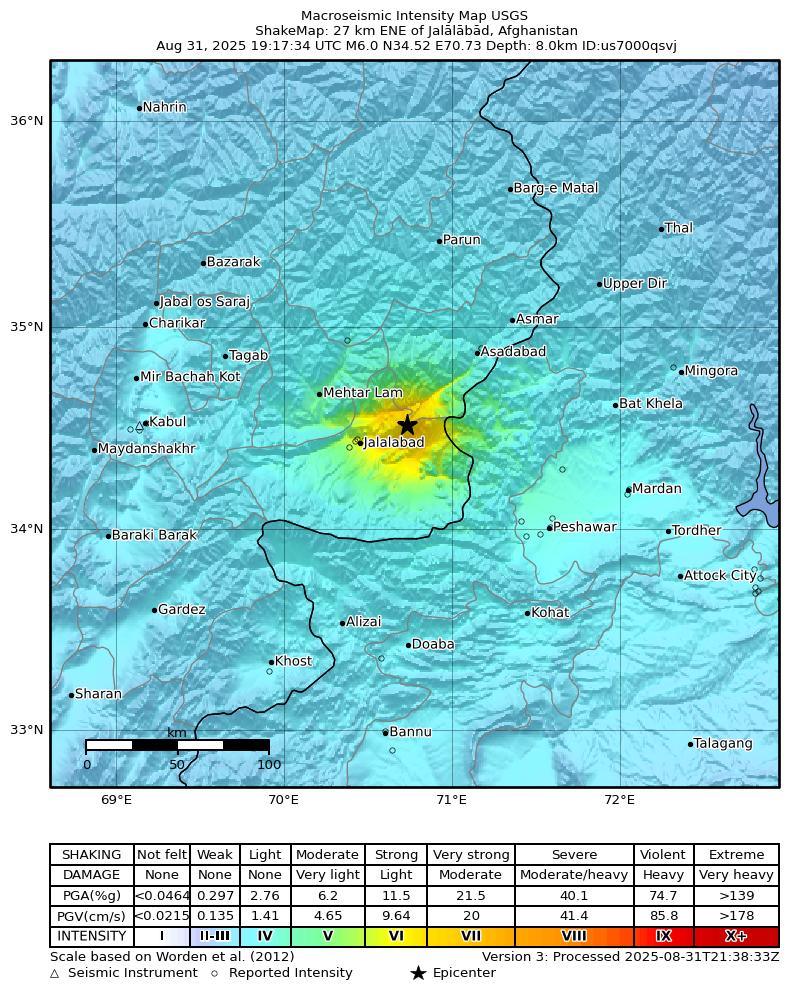
This map comes from the US Geological Survey (USGS). The black star marks the epicentre of the earthquake, just outside Jalalabad in eastern Afghanistan.
The colours show how strongly the shaking was felt:
Yellow to orange means very strong shaking that can cause heavy damage.
Green and blue show lighter shaking felt further away.
The closer you are to the epicentre, the more dangerous the shaking and the greater the damage to homes and health facilities.
Many villages in the yellow-orange zone suffered the worst destruction, where buildings collapsed and whole families were trapped.